Our Story — The Winemakers
Five winemakers in five decades
Continuity is the rarest thing in wine. Since the first bottle under the Kanonkop label in 1973, just five people have held the cellar keys.
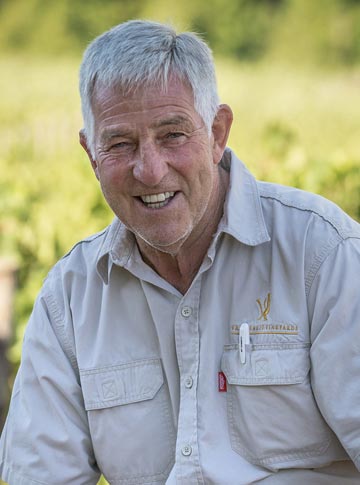
1968 – 1980
Jan “Boland” Coetzee
The Springbok flanker who bottled the maiden Kanonkop Pinotage and Cabernet Sauvignon in 1973 — the farm speaking with its own voice at last.
He arrived in 1968 to learn the ropes from Danie Rossouw, who had planted the first vines here with Paul Sauer himself. There was almost no time: Danie died the following April, and Jan brought in the 1969 harvest largely alone. The Cabernet that made the maiden 1973 came off a block he had planted in 1969 from Danie's own rootstocks — vines just four years old.
He read this ground early. Sensing what the decomposed granite and clay of the upper slopes could do, he trucked in limestone by the ton to correct the acidity — a correction the Pinotage and Cabernet planted there are still drawing on. He also insisted, against every convention of the day, that wine bearing the farm's name be matured in new French oak, and won the argument barrel by expensive barrel. That decision has never been revisited.
His legacy runs deeper than wine: the houses with electricity and running water, the sports fields and the community hall he drove for in the 1970s still anchor life on the farm today. In 2019 Stellenbosch University awarded him an honorary doctorate for his contribution to South African wine.
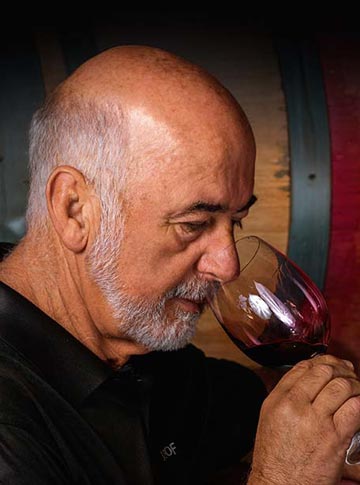
1980 – 2002
Beyers Truter
Named international winemaker of the year in 1991 — the moment the world learned what Stellenbosch already knew.
He wanted the job before it existed. As a student he would walk up to Jan Boland at the Stellenbosch food and wine festival and tell him, plainly, “One day I'm going to have your job.” He got it at 25, and by his own account it took him weeks to find the nerve to unlock the cellar door.
Then he changed how the wine is made. Trial by trial, he found that punching down the skins by hand every two hours — rather than every six or eight — drew far better colour and tannin from the fruit. That regimen is still followed here, through every night of every harvest, and it is the single practice most responsible for the shape of a Kanonkop red.
He introduced the Paul Sauer blend in 1981, from a site everyone had written off — the poorest soils on the farm, grazed by sheep a few years earlier, now the most valuable ground we own. And he made Pinotage his life's argument at a time when the variety was the industry's black sheep. When the 1989 Pinotage won him the Robert Mondavi Trophy in London, his first thought was that he wished the award had gone to the wine. No serious conversation about Pinotage has excluded this farm since.
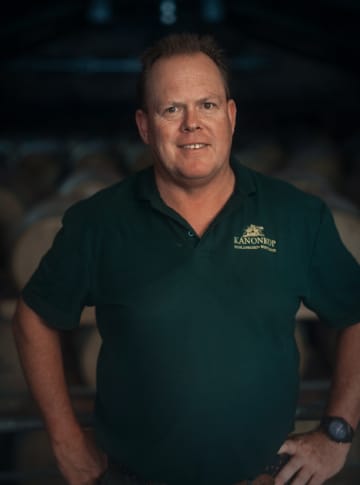
2002 – 2024
Abrie Beeslaar
Twenty-two vintages of stewardship, and the era of the Black Label Pinotage — released in 2006 from bush vines planted in 1953, South Africa's definitive icon Pinotage.
He was handed the cellar before he turned thirty, with one instruction from Johann Krige: “This is Kanonkop. We don't re-invent the wheel here.” He didn't. He made one change, and it was a matter of noticing rather than inventing — the fruit from the 1953 block was already kept apart until blending, and he argued it should never be blended away at all. From 2006 it has been bottled on its own as Black Label.
Three times — in 2008, 2015 and 2017 — he was named International Winemaker of the Year at the International Wine & Spirit Competition in London. In 2018 the Paul Sauer 2015 became the first South African wine ever awarded a perfect 100 points. He credits the ground and the men before him: “You have to look way beyond the current winemaker for reasons behind the Kanonkop success.”
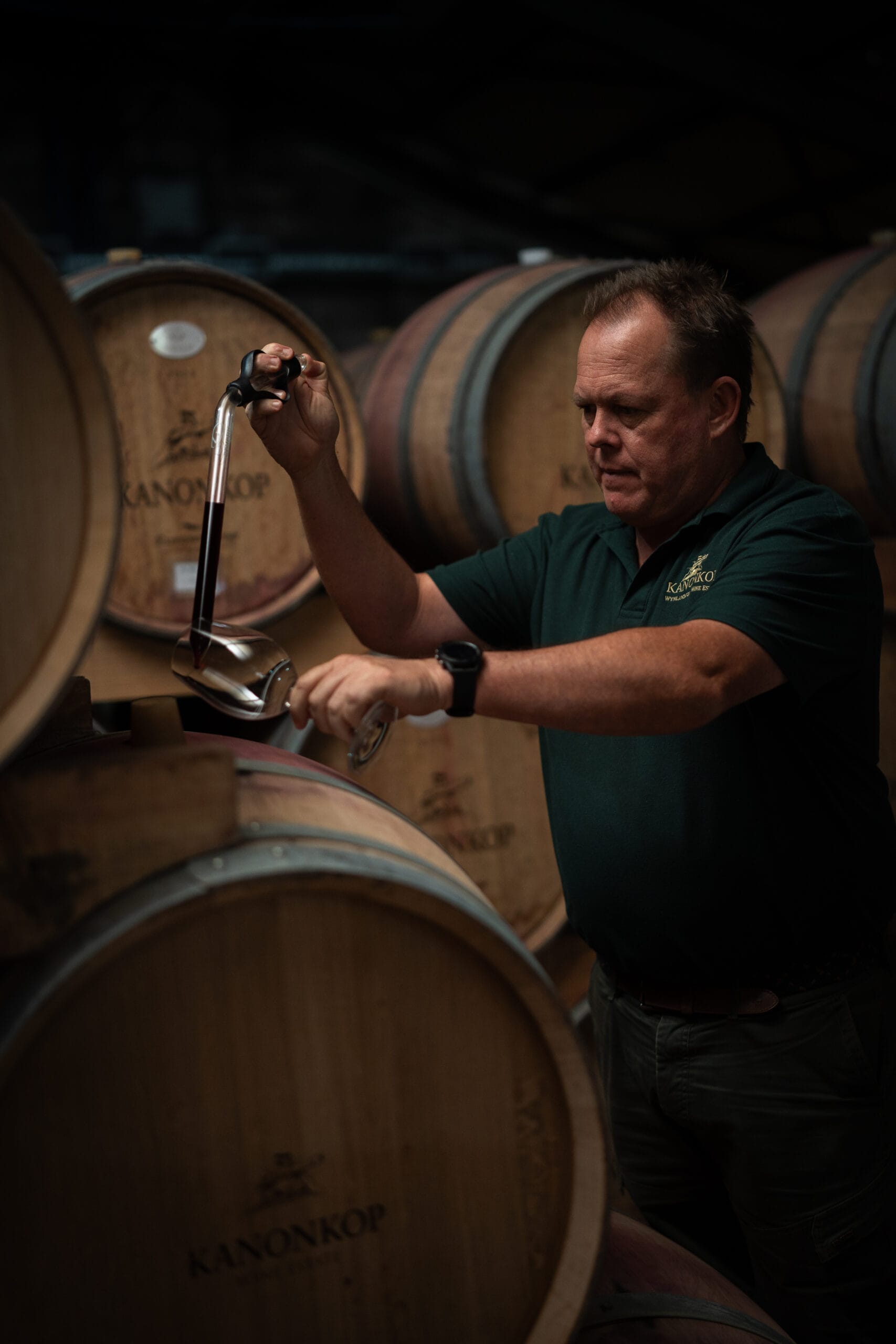
2024 – · Head Winemaker
Francois van Zyl
His mind was made up by a glass of the 1991 Paul Sauer. He took the cellar keys from Abrie Beeslaar in November 2024 — the fifth custodian of an unbroken style.
Winemaker
Dirk van Zyl
Alongside Francois in the cellar, carrying the same two-hourly punch-downs through the same open concrete tanks that have made every Kanonkop vintage since 1973.